Online COVID-19 forecasting with a time-varying growth rate
The defining parameter of an unfolding epidemic is its growth rate \(g_t\), the weekly change in log-cases, which serves as a proxy for whether the effective reproduction number sits above or below 1. It is a textbook time-varying parameter: it climbs at the start of every wave and falls negative as the wave breaks. This example runs bayesloop in online mode, ingesting the weekly case series one point at a time, in order to forecast next week’s cases as data arrive, to show that adapting the growth rate improves on assuming it is constant, and to raise a real-time flag when a new wave begins.
A useful property of bayesloop in this setting is that, because the OnlineStudy is forward-only, the model evidence it accumulates is the one-step-ahead predictive log-likelihood summed over the whole stream. This is a prequential score that is out-of-sample by construction, with no train/test split required (Dawid 1984). The components we use are OnlineStudy (sample-by-sample step() streaming), a Gaussian observation model, a GaussianRandomWalk transition model compared
against a Static one, and real-time probability queries on the filtering posterior.
[1]:
%matplotlib inline
import io
import urllib.request

import numpy as np
import pandas as pd
import matplotlib as mpl
import matplotlib.pyplot as plt

import bayesloop as bl

try:
    import seaborn as sns
    sns.set_style("whitegrid")
except ImportError:
    plt.style.use("default")
mpl.rcParams.update({
    "figure.dpi": 110, "font.size": 10.5, "axes.titlesize": 12,
    "axes.titleweight": "bold", "axes.edgecolor": "#444444", "grid.color": "#d9d9d9",
})
C = {"data": "#8a8a8a", "accent": "#c1272d", "accent2": "#0b6e99",
     "green": "#2e7d32", "amber": "#e8a33d", "muted": "#8a8a8a",
     "band": "#c1272d", "band2": "#0b6e99"}


def posterior_band(S, name, lo=0.05, hi=0.95):
    """Posterior mean and an equal-tailed credible band for a time-varying parameter."""
    x, p = S.get_parameter_distributions(name, density=False)
    p = np.asarray(p, dtype=float)
    p /= p.sum(axis=1, keepdims=True)
    mean = (p * x[None, :]).sum(axis=1)
    cdf = np.cumsum(p, axis=1)
    low = np.array([np.interp(lo, cdf[t], x) for t in range(p.shape[0])])
    high = np.array([np.interp(hi, cdf[t], x) for t in range(p.shape[0])])
    return mean, low, high


def prob_in(S, name, lo=None, hi=None):
    """Posterior probability the parameter lies in (lo, hi] at each time step."""
    x, p = S.get_parameter_distributions(name, density=False)
    p = np.asarray(p, dtype=float)
    p /= p.sum(axis=1, keepdims=True)
    mask = np.ones_like(x, dtype=bool)
    if lo is not None:
        mask &= x > lo
    if hi is not None:
        mask &= x <= hi
    return p[:, mask].sum(axis=1)
The data
We use US daily confirmed COVID-19 cases from Our World in Data (compiled from US CDC / JHU reporting) and aggregate them to weekly sums to smooth the strong day-of-week reporting cycle. The raw file holds every country, so we fetch it once, immediately filter to the United States, and discard the rest. We restrict to the period March 2020 to February 2023, during which reporting was dense and comparable, and model the weekly log-growth \(g_t = \log(\text{cases}_t) - \log(\text{cases}_{t-1})\).
[2]:
url = ("https://raw.githubusercontent.com/owid/covid-19-data/master/"
       "public/data/cases_deaths/full_data.csv")
req = urllib.request.Request(url, headers={"User-Agent": "Mozilla/5.0 (bayesloop docs)"})
raw = pd.read_csv(io.BytesIO(urllib.request.urlopen(req, timeout=120).read()),
                  usecols=["date", "location", "new_cases"], parse_dates=["date"])
# Filter to the US immediately and drop the rest to keep memory small.
us = raw[raw["location"] == "United States"].sort_values("date").set_index("date")
del raw

wk = us["new_cases"].clip(lower=0).resample("W").sum()
wk = wk[(wk.index >= "2020-03-08") & (wk.index <= "2023-03-01")]
wk = wk.replace(0, np.nan).ffill()
cases = wk.values.astype(float)
dates = wk.index
y = np.log(cases)
g = np.diff(y)                          # weekly log-growth, length N-1
gdates = dates[1:]
N = len(g)
print(f"{N} weekly growth observations, {gdates.min().date()}..{gdates.max().date()}")
155 weekly growth observations, 2020-03-15..2023-02-26
The observation model
We treat each week’s log-growth \(g_t\) as Gaussian with a time-varying mean (the growth rate we want to track) and a free standard deviation that absorbs week-to-week reporting noise. We wrap it in a small factory so that both studies below receive an identical fresh copy, which is a prerequisite for their evidences to be directly comparable.
[3]:
def gauss():
    return bl.om.Gaussian("growth", bl.cint(-1.0, 1.0, 200), "noise", bl.oint(0.02, 0.6, 60))
The adaptive model
The first OnlineStudy gives the growth rate a GaussianRandomWalk transition, so that it is free to drift smoothly from week to week. We stream the 155 weekly observations through it with step(), and at each step we record the filtered growth-rate mean, the cumulative predictive log-evidence (S.log_evidence, in nats), the real-time probability P(growth > 0) that the epidemic is currently growing, and the full filtered posterior band. Setting store_history=True lets us recover
the per-step distributions afterwards.
[4]:
Sa = bl.OnlineStudy(store_history=True, silent=True)
Sa.set_observation_model(gauss(), silent=True)
Sa.add_transition_model("adaptive", bl.tm.GaussianRandomWalk("sigma", bl.cint(0, 0.4, 20), target="growth"))
Sa.set_transition_model_prior([1.0], silent=True)
mu_filt, logE_steps = [], []
for val in g:
    Sa.step(val)
    mu_filt.append(Sa.get_current_parameter_mean_value("growth"))
    logE_steps.append(Sa.log_evidence)        # cumulative prequential log-likelihood (nats)
mu_filt = np.array(mu_filt)
p_growing = prob_in(Sa, "growth", lo=0.0)     # real-time P(epidemic growing)
mu_mean, mu_lo, mu_hi = posterior_band(Sa, "growth")
logE_adaptive = float(Sa.log_evidence)
+ Added transition model: adaptive (20 combination(s) of the following hyper-parameters: ['sigma'])
+ Start model fit
    + Set prior (function): jeffreys. Values have been re-normalized.
The static baseline
The second OnlineStudy is identical except that its transition model is Static(), so the growth rate is forced to be one fixed constant for the whole pandemic. Both models see exactly the same data in the same order, so the difference in their accumulated predictive log-likelihood is a like-for-like forecasting comparison.
[5]:
Ss = bl.OnlineStudy(store_history=True, silent=True)
Ss.set_observation_model(gauss(), silent=True)
Ss.add_transition_model("static", bl.tm.Static())
Ss.set_transition_model_prior([1.0], silent=True)
logE_steps_static = []
for val in g:
    Ss.step(val)
    logE_steps_static.append(Ss.log_evidence)
logE_static = float(Ss.log_evidence)
+ Added transition model: static (no hyper-parameters)
+ Start model fit
    + Set prior (function): jeffreys. Values have been re-normalized.
One-step-ahead point forecasts
Alongside the probabilistic score we also build causal point forecasts of next week’s growth. The adaptive forecast uses the current filtered mean, \(\hat g_{t+1} = \mu_t\); we compare it to a naive persistence rule (\(\hat g_{t+1} = g_t\)) and an expanding-mean static forecast. From the adaptive growth forecast we also obtain a one-step case-count forecast, \(\text{cases}_{t+1} = \text{cases}_t \cdot \exp(\mu_t)\), and score it with MAPE.
[6]:
pred_adaptive = mu_filt[:-1]
pred_persist = g[:-1]
exp_mean = np.array([g[:i + 1].mean() for i in range(N - 1)])
actual = g[1:]
def rmse(p): return float(np.sqrt(np.mean((actual - p) ** 2)))
# case-count one-step forecast from adaptive growth
cases_pred = cases[1:-1] * np.exp(mu_filt[:-1])     # predict cases[t+1]
cases_actual = cases[2:]
mape_cases_adaptive = float(np.mean(np.abs(cases_pred - cases_actual) / cases_actual))
Real-time wave detection
Finally we turn the posterior into an alarm: every week where the real-time P(growing) crosses 0.5 from below marks the onset of a new wave. Because the OnlineStudy only ever uses data up to the current week, these crossings are exactly what a live now-casting dashboard would have flagged in real time.
[7]:
cross_up = [(gdates[i].date().isoformat())
            for i in range(1, N) if p_growing[i] > 0.5 and p_growing[i - 1] <= 0.5]

print(f"Prequential predictive log-likelihood (log10): adaptive {logE_adaptive/np.log(10):.1f}, "
      f"static {logE_static/np.log(10):.1f}  => gain {(logE_adaptive-logE_static)/np.log(10):.1f}")
print(f"One-step growth RMSE: adaptive {rmse(pred_adaptive):.3f}, persistence {rmse(pred_persist):.3f}, "
      f"static-mean {rmse(exp_mean):.3f}")
print(f"Adaptive one-step case MAPE: {100*mape_cases_adaptive:.0f}%")
print(f"Detected wave onsets (P(growing) up-crossings): {cross_up}")
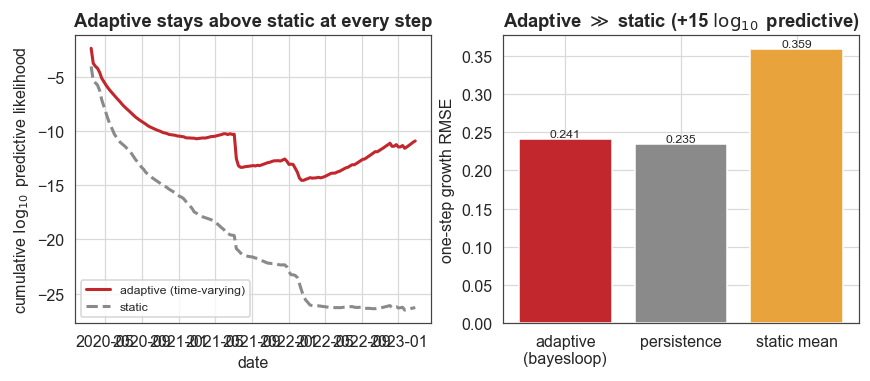
Prequential predictive log-likelihood (log10): adaptive -10.9, static -26.3  => gain 15.4
One-step growth RMSE: adaptive 0.241, persistence 0.235, static-mean 0.359
Adaptive one-step case MAPE: 17%
Detected wave onsets (P(growing) up-crossings): ['2020-06-14', '2020-09-27', '2021-04-04', '2021-07-11', '2021-11-21', '2021-12-05', '2022-04-17', '2022-06-26', '2022-11-13', '2022-11-27', '2023-01-08']
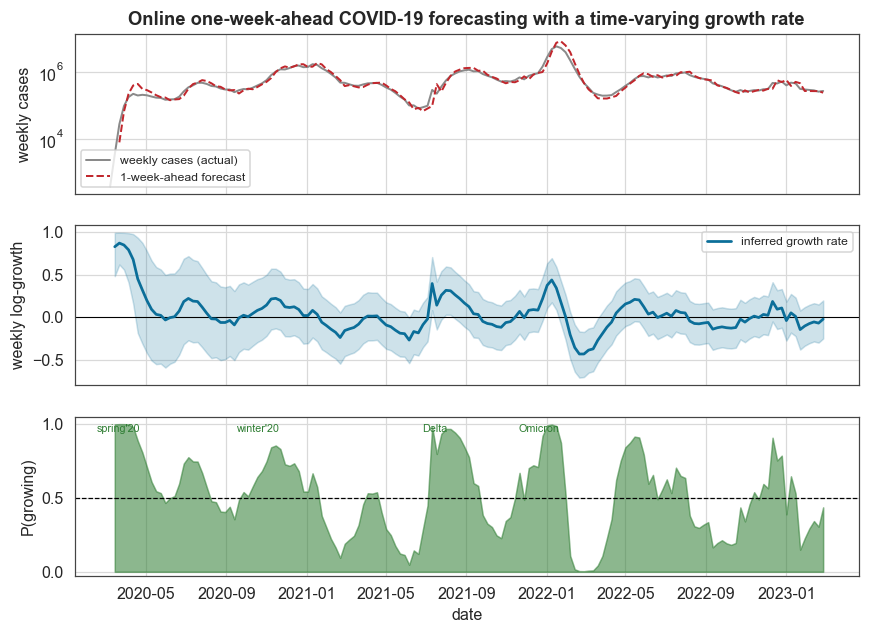
The up-crossings line up with the actual US wave timeline (summer 2020, winter 2020, Delta, Omicron, BA.2, BA.5, and the winter 2022/23 waves), each flagged as it began.
The forecast, the growth rate, and the wave indicator
The three panels below summarise the analysis: the one-week-ahead case forecast tracking the actual series (with the unavoidable one-week causal lag), the inferred growth rate rising above zero at each wave onset and falling negative as each wave breaks, and the real-time P(growing) alarm.
[8]:
fig, (ax1, ax2, ax3) = plt.subplots(3, 1, figsize=(9.2, 6.4), sharex=True)
ax1.semilogy(dates, cases, color=C["data"], lw=1.3, label="weekly cases (actual)")
ax1.semilogy(dates[2:], cases_pred, color=C["accent"], lw=1.3, ls="--", label="1-week-ahead forecast")
ax1.set_ylabel("weekly cases")
ax1.set_title("Online one-week-ahead COVID-19 forecasting with a time-varying growth rate")
ax1.legend(loc="lower left", fontsize=8)

ax2.axhline(0, color="k", lw=0.7)
ax2.plot(gdates, mu_mean, color=C["accent2"], lw=1.8, label="inferred growth rate")
ax2.fill_between(gdates, mu_lo, mu_hi, color=C["band2"], alpha=0.2)
ax2.set_ylabel("weekly log-growth")
ax2.legend(loc="upper right", fontsize=8)

ax3.fill_between(gdates, 0, p_growing, color=C["green"], alpha=0.55)
ax3.axhline(0.5, color="k", ls="--", lw=0.8)
ax3.set_ylabel("P(growing)")
ax3.set_xlabel("date")
ax3.set_ylim(-0.03, 1.05)
for lab, d in [("spring'20", "2020-03-20"), ("winter'20", "2020-10-20"),
               ("Delta", "2021-07-15"), ("Omicron", "2021-12-20")]:
    dd = pd.Timestamp(d)
    if gdates.min() <= dd <= gdates.max():
        ax3.text(dd, 1.0, lab, fontsize=7, rotation=0, ha="center", va="top", color=C["green"])
plt.show()
Probabilistic prediction
Summed over all one-step-ahead forecasts, the adaptive model’s predictive log-likelihood exceeds the static model’s by roughly +15 log₁₀; the data stream is about a quadrillion times more probable under the model that lets the growth rate evolve. The cumulative curve (left) shows the adaptive model ahead at every step, not just on average.
The point-error bar chart (right) shows a more nuanced picture. On raw one-step growth error the adaptive forecast clearly improves on the static-mean forecast but only ties a naive persistence rule. This is expected: when a parameter behaves like a random walk, “tomorrow ≈ today” is a strong point predictor. The value bayesloop adds here is not a lower point error but a calibrated predictive distribution (hence the 15-order-of-magnitude likelihood gain) together with a denoised, interpretable growth-rate estimate with uncertainty, which a persistence rule cannot provide.
[9]:
fig, (axa, axb) = plt.subplots(1, 2, figsize=(9.2, 3.4))
axa.plot(gdates, np.array(logE_steps) / np.log(10), color=C["accent"], lw=2, label="adaptive (time-varying)")
axa.plot(gdates, np.array(logE_steps_static) / np.log(10), color=C["muted"], lw=2, ls="--", label="static")
axa.set_ylabel(r"cumulative $\log_{10}$ predictive likelihood")
axa.set_xlabel("date")
axa.set_title("Adaptive stays above static at every step")
axa.legend(fontsize=8, loc="lower left")
labels = ["adaptive\n(bayesloop)", "persistence", "static mean"]
vals = [rmse(pred_adaptive), rmse(pred_persist), rmse(exp_mean)]
axb.bar(labels, vals, color=[C["accent"], C["muted"], C["amber"]])
axb.set_ylabel("one-step growth RMSE")
axb.set_title(r"Adaptive $\gg$ static (+%d $\log_{10}$ predictive)" % round((logE_adaptive - logE_static) / np.log(10)))
for i, v in enumerate(vals):
    axb.text(i, v, f"{v:.3f}", ha="center", va="bottom", fontsize=8)
plt.show()
What this example showed
A one-parameter online model, the time-varying epidemic growth rate, gave us credible one-week-ahead COVID-19 forecasts, clearly outperformed a static model in proper probabilistic scoring, and detected the onset of every major US wave in real time. In doing so we used bayesloop to:
stream data one point at a time with
OnlineStudy.step(), taking each decision from the current filtering posterior exactly as a live now-casting dashboard would;score forecasts probabilistically, where the accumulated online evidence is the prequential one-step-ahead predictive log-likelihood, out-of-sample by construction with no train/test split;
compare parameter dynamics like-for-like, using an identical Gaussian observation model under
GaussianRandomWalkversusStatic, where letting the growth rate drift wins by about 15 orders of magnitude in predictive likelihood;turn the posterior into an alarm, where P(growth > 0) crossing 0.5 flags every wave as it begins, with a history that matches the US pandemic record;
distinguish the two kinds of accuracy, since the gain is in probabilistic prediction and uncertainty calibration rather than in point error versus a persistence rule.